
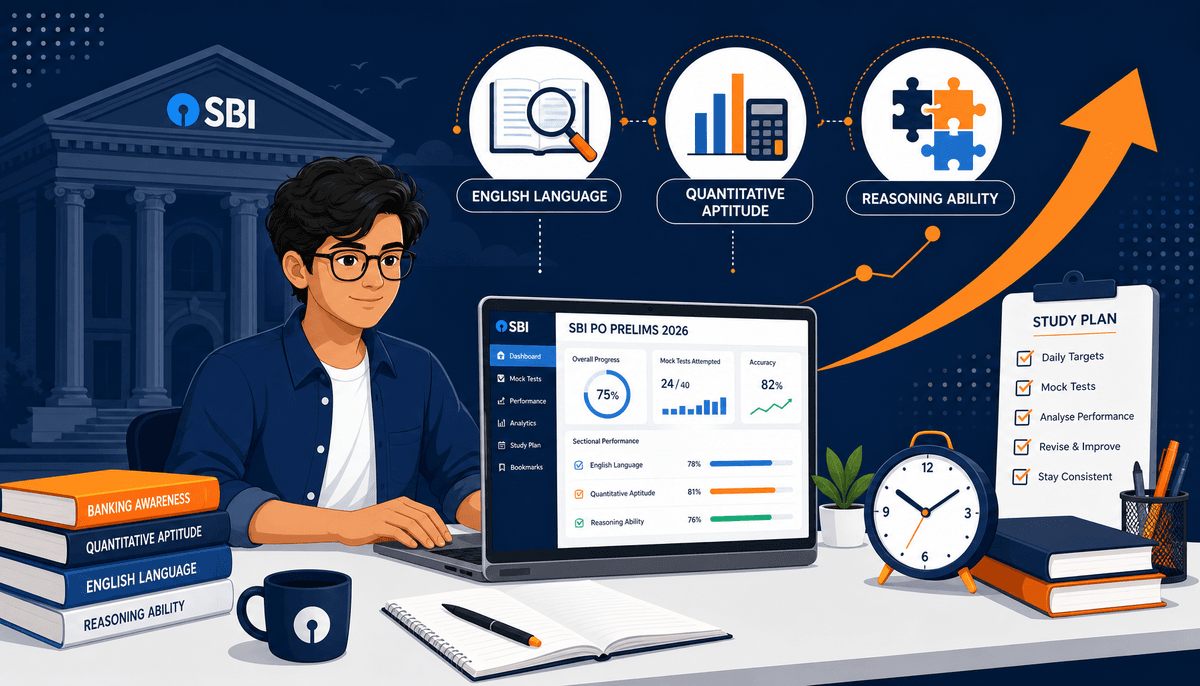
The State Bank of India Probationary Officer (SBI PO) examination is one of the most sought-after banking jobs in India, attracting lakhs of aspirants every year. With competition intensifying each cycle, a focused and strategic approach to the Preliminary examination is essential. This guide breaks down everything you need to know to crack SBI PO Prelims 2026.SSC Eligibility
Understanding the SBI PO Prelims Exam Pattern
Before diving into preparation, you must master the exam structure. The Preliminary examination is an online, objective-type test designed as a screening round.
| Section | Questions | Marks | Duration |
|---|---|---|---|
| English Language | 30 | 30 | 20 minutes |
| Quantitative Aptitude | 35 | 35 | 20 minutes |
| Reasoning Ability | 35 | 35 | 20 minutes |
| Total | 100 | 100 | 60 minutes |
Key points to remember:
- There is a sectional time limit of 20 minutes for each section — you cannot move freely between sections.
- A negative marking of 0.25 marks applies for every wrong answer.
- You must clear the sectional cut-off as well as the overall cut-off to qualify for Mains.
- Prelims marks are not counted in the final merit list, but qualifying is mandatory.
Section-Wise Preparation Strategy
1. English Language (30 Marks)
This section tests your grammar, vocabulary, and comprehension speed. Focus areas:
- Reading Comprehension: Practice 2–3 passages daily. Learn to skim for the main idea and scan for specific details. Economy and banking-related passages are common.
- Grammar: Master error detection, sentence correction, and fillers. Revise rules of tenses, subject-verb agreement, prepositions, and articles.
- Vocabulary: Build a habit of reading editorials from The Hindu or Indian Express. Maintain a daily word list with synonyms, antonyms, and usage.
- New-pattern questions: Practice sentence rearrangement (para jumbles), word swaps, and connectors, as these appear frequently.
Tip: Aim to attempt 22–25 questions accurately. Don’t get stuck on tricky vocabulary — prioritize comprehension and grammar where accuracy is higher.
2. Quantitative Aptitude (35 Marks)
Often considered the toughest section, Quant rewards speed and calculation accuracy.
- Data Interpretation (DI): This carries the highest weight. Practice tables, bar graphs, line charts, pie charts, and caselet DI. Expect 2–3 sets in the exam.
- Simplification & Approximation: These are scoring and quick. Strengthen your BODMAS and mental math.
- Number Series: Learn to spot patterns — squares, cubes, prime numbers, and arithmetic/geometric progressions.
- Quadratic Equations: Practice the comparison method for speed.
- Arithmetic Word Problems: Cover percentages, profit & loss, time & work, time-speed-distance, simple & compound interest, ratio & proportion, ages, partnership, and averages.
Tip: Memorize tables up to 25, squares up to 30, cubes up to 20, and fractions-to-percentage conversions. This single habit can save you precious minutes.
3. Reasoning Ability (35 Marks)
This section is the best opportunity to maximize your score with practice.
- Puzzles & Seating Arrangement: The backbone of this section. Practice linear, circular, floor-based, box-based, and scheduling puzzles daily. Expect 3–4 sets.
- Syllogism: Use the Venn diagram method for accuracy.
- Inequality: Learn coded and direct inequalities.
- Blood Relations, Direction Sense, Order & Ranking: These are quick scorers — don’t skip them.
- Coding-Decoding & Alphanumeric Series: Practice new-pattern questions regularly.
Tip: Start with easy puzzles and standalone topics (syllogism, inequality, blood relations) before attempting complex arrangements. This locks in guaranteed marks early.AP GENCO AEE
A Realistic Preparation Timeline
For aspirants starting 3–4 months before the exam:
Month 1 — Build the foundation: Cover the basic concepts of all topics. Spend 5–6 hours daily split across the three sections. Focus on clarity, not speed.
Month 2 — Topic-wise practice: Solve 30–40 questions per topic. Begin timing yourself. Identify weak areas and revisit fundamentals.
Month 3 — Sectional & full mock tests: Attempt at least one full-length mock every 2–3 days. Analyze each mock thoroughly.
Final 2 weeks — Revision & mocks: Take a mock daily, revise formulas, and avoid learning new topics. Focus on accuracy and exam temperament.
The Importance of Mock Tests and Analysis
Mock tests are non-negotiable for SBI PO success. They help you:
- Develop a time-management strategy under the sectional clock.
- Identify your strongest section to attempt first for confidence and marks.
- Understand the trade-off between speed and accuracy given negative marking.
The golden rule: Analysis matters more than attempting. After every mock, spend at least an hour reviewing mistakes, noting silly errors, and re-solving unattempted questions. Maintain an error log and revisit it weekly.IBPS RRB
Smart Time-Management Tips for the Exam Day
- Reasoning first, then Quant, then English — or any order that suits your strengths. Many toppers start with their strongest section.
- Within each 20-minute window, skip lengthy questions in the first pass and return only if time permits.
- Don’t gamble on negative marking — attempt only when you are reasonably confident.
- Aim for roughly 75–80 accurate attempts overall to comfortably clear cut-offs (though this varies by exam difficulty).
Recommended Resources
- Quant: Quantitative Aptitude by R.S. Aggarwal; daily DI practice from a reputed online platform.
- Reasoning: A Modern Approach to Verbal & Non-Verbal Reasoning; daily puzzle practice.
- English: Word Power Made Easy; daily editorial reading.
- Current Awareness: Though not in Prelims, start early for the Mains banking awareness section.
- Mock Tests: Subscribe to a reliable test series and attempt sectional plus full-length tests consistently.
Common Mistakes to Avoid
- Ignoring the sectional time limit during practice — always simulate real conditions.
- Spending too long on a single puzzle or DI set and running out of time.
- Neglecting mock analysis and simply piling up attempts.
- Underestimating the English section — sectional cut-offs trip up many strong candidates here.
- Last-minute cramming of new topics instead of revising known ones.
Final Words
Cracking SBI PO Prelims 2026 is entirely achievable with discipline, the right strategy, and consistent practice. Focus on building speed without sacrificing accuracy, take mock tests seriously, and analyze every mistake. Stay consistent, manage the sectional clock wisely, and trust your preparation on exam day.
Start early, practice smart, and stay confident. Your banking career awaits.

About the Author
saritha
Professional content writer with two years of experience in government job content. He provides accurate and timely updates on SSC, UPSC, Banking, Railways, and State PSC notifications, admit cards, answer keys, and results for aspirants across India.