
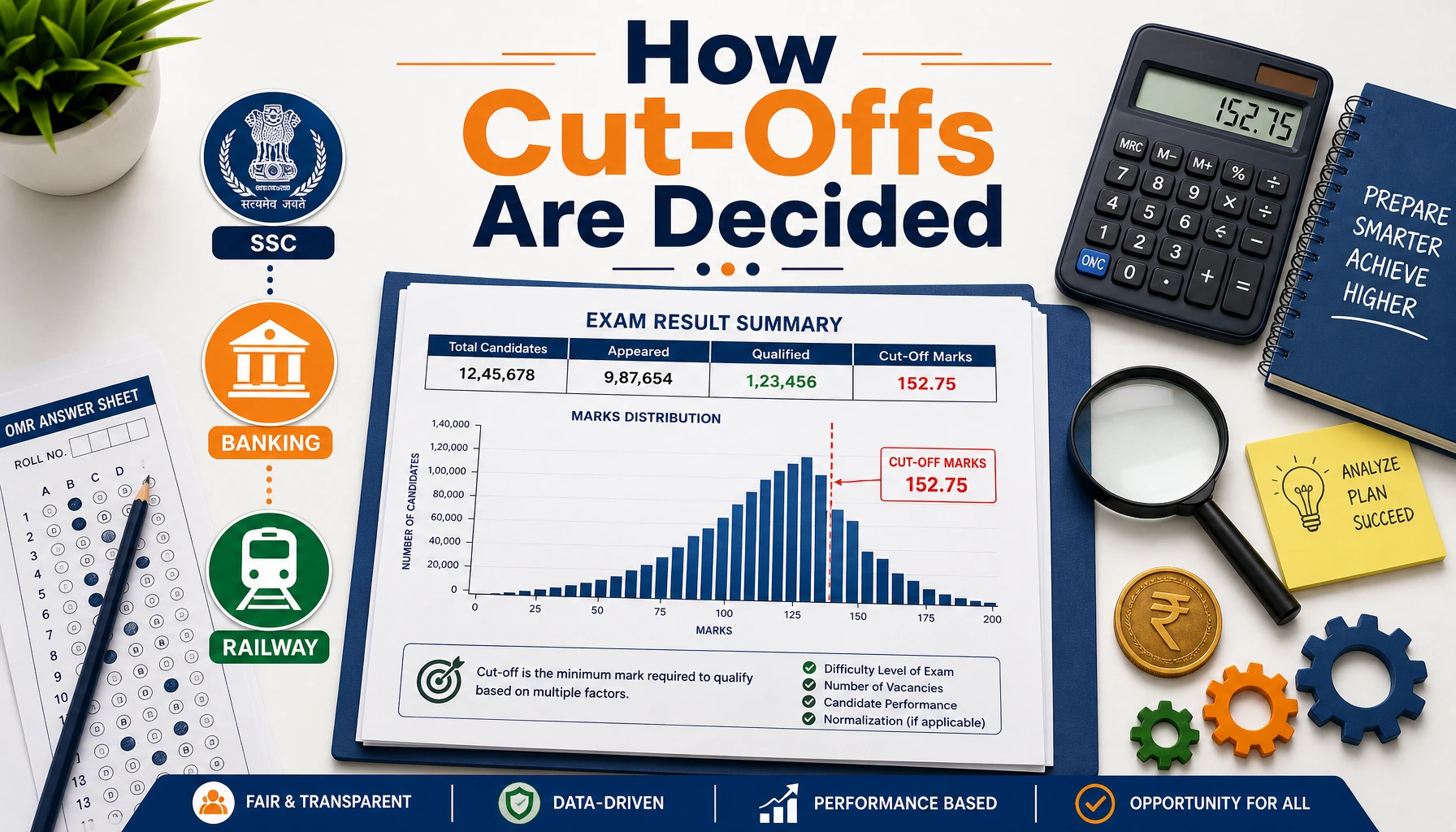
Every year, lakhs of aspirants check their sarkari result and ask the same question: “I scored well — why didn’t I clear the cut-off?” The answer lies in how cut-off marks are actually calculated. Cut-offs are not fixed numbers announced in advance; they are decided after the exam based on several moving factors. This guide explains how SSC, IBPS/SBI, and Railway (RRB) cut-offs are determined, why they change every year, and how you can set a realistic safe score for your target exam.IBPS RRB
What Is a Cut-Off Mark?
A cut-off is the minimum score required to qualify for the next stage of a recruitment process or for final selection. If your marks are equal to or above the cut-off for your category, you move ahead; if not, you are out of the race for that cycle.
There are usually two layers of cut-offs:
- Sectional cut-off – the minimum marks required in each individual section (common in banking exams).
- Overall cut-off – the minimum total score across all sections combined.
In exams like IBPS PO or SBI Clerk, you must clear both. Scoring 90/100 overall means nothing if you fail the English sectional cut-off by half a mark.
Who Decides the Cut-Off?
The recruiting body decides it — SSC for Staff Selection Commission exams, IBPS/SBI for banking, and the Railway Recruitment Boards (RRBs) for railway exams. The cut-off is finalised only after the exam is conducted and answer keys are processed, because it depends on how candidates actually performed.gk tricks
The 6 Factors That Decide Cut-Off Marks
1. Number of Vacancies
This is the single biggest factor. Recruiting bodies typically shortlist candidates in a fixed ratio to vacancies — for example, SSC often calls around 20 times the number of vacancies to the next tier for some posts, while RRB NTPC shortlisted candidates at 20 times the vacancies for CBT-2 in past cycles.
- More vacancies → lower cut-off (more candidates need to qualify)
- Fewer vacancies → higher cut-off (competition for each seat intensifies)
This is why a year with 10,000+ vacancies (like some RRB Group D cycles) sees noticeably lower cut-offs than a year with 3,000 vacancies for the same post.
2. Number of Candidates Appearing
Higher applicant turnout increases competition. When the applicant-to-vacancy ratio worsens, the cut-off climbs. Railway exams routinely see over one crore applications, which is a key reason RRB cut-offs (after normalisation) tend to be steep despite large vacancy counts.online ssc coaching
3. Difficulty Level of the Paper
If the paper is tough, average scores fall across the board and the cut-off drops. If the paper is easy, everyone scores high and the cut-off rises. This is why comparing raw scores across different years — or even different shifts — is misleading.
4. Normalisation Across Shifts
SSC, IBPS, and RRB exams are conducted in multiple shifts with different question papers. Since some shifts are inevitably harder than others, boards apply a normalisation formula to adjust raw scores to a common scale.
- Your normalised score, not your raw score, is compared against the cut-off.
- A candidate scoring 85 raw marks in a difficult shift may end up with a normalised score higher than someone scoring 90 in an easy shift.
This is the most misunderstood part of cut-offs. Aspirants often panic seeing “cut-off higher than total attempted questions in my shift” — that’s normalisation at work.
5. Category-Wise Reservation
Cut-offs are released separately for UR (General), OBC, EWS, SC, ST, and often ESM (Ex-Servicemen) and PwBD categories. Reserved-category cut-offs are generally lower than UR, but in highly competitive exams like SSC CGL, the gap between UR and OBC cut-offs has narrowed considerably in recent years — sometimes to just a few marks.
6. Previous Year Trends and Marking Scheme
Boards look at historical performance data, and the negative marking scheme shapes score distribution. SSC deducts 0.50 marks per wrong answer in most Tier-1 exams (0.25 in some papers like CHSL Tier-1 earlier pattern — always verify the current notification), banking prelims deduct 0.25 of the marks assigned, and RRB deducts one-third of a mark. Heavier negative marking suppresses average scores and pulls cut-offs down.
How Cut-Offs Work Exam by Exam
SSC Exams (CGL, CHSL, MTS, GD Constable)
- SSC releases tier-wise, category-wise, and often post-wise cut-offs.
- In SSC CGL, the Tier-1 cut-off varies by post group because different posts have different subsequent papers (e.g., AAO, JSO, and general posts have separate lists).
- Final selection depends on combined marks across tiers, so clearing Tier-1 cut-off is only a gate, not a guarantee.
- SSC applies normalisation using its published formula whenever an exam runs in multiple shifts.
Banking Exams (IBPS PO/Clerk, SBI PO/Clerk, RRB Office Assistant/Officer Scale-I)
- Banking exams have two-stage cut-offs: Prelims (qualifying) and Mains (score carried to final merit in most cases).
- Sectional cut-offs apply at both stages in most IBPS exams — you must qualify in English, Quant, and Reasoning individually. (SBI has removed sectional cut-offs in some recent cycles; always check the latest notification.)
- Prelims marks are usually not counted in the final merit list — they only qualify you for Mains.
- IBPS RRB cut-offs also vary state-wise, since vacancies are state-specific.
Railway Exams (RRB NTPC, Group D, ALP, JE)
- RRB cut-offs are released zone-wise (RRB-wise) because each Railway Recruitment Board recruits for its own region.
- The same exam can have a cut-off of 75 in one RRB and 85 in another, depending on regional vacancies and applicant numbers.
- RRB uses percentile-based normalisation across shifts, and shortlisting for CBT-2 is done at a multiple of vacancies (commonly 15–20 times).
- Community-wise (UR/OBC/SC/ST/EWS) and horizontal (ESM, PwBD, CCAA) cut-offs are published separately.
Expected vs Official Cut-Off: Don’t Confuse the Two
After every exam, coaching institutes publish “expected cut-offs” based on student feedback and answer keys. These are estimates, sometimes off by 5–10 marks. The only cut-off that matters is the official one released by SSC/IBPS/RRB along with the result on their official websites (ssc.gov.in, ibps.in, and the respective RRB portals). Treat expected cut-offs as rough guidance for deciding whether to start preparing for the next stage — nothing more.
How to Set Your Safe Score
A practical rule followed by toppers: target 10–15% above the previous year’s UR cut-off, regardless of your category. Here’s why:
- Cut-offs fluctuate year to year; a buffer absorbs the swing.
- Normalisation can move your score in either direction.
- In exams where mains marks decide final merit, clearing cut-off barely means little — merit rank decides the post you get.
Steps to build your target:
- Pull the last 3 years’ cut-offs for your exam, category, and (for RRB) your zone.
- Note the vacancy count in those years versus the current notification.
- If vacancies are down, assume the cut-off will rise; set your mock test target accordingly.
- Track your normalised-equivalent performance by comparing your mock percentile, not just raw marks.
Common Myths About Cut-Offs
Myth 1: Cut-offs are fixed before the exam. No. Statutory qualifying marks (like UPSC’s minimum standards or RRB’s 40% UR / 30% SC-ST qualifying levels) are pre-declared, but the actual competitive cut-off is always higher and decided post-exam.
Myth 2: Clearing the cut-off means selection. Clearing a stage cut-off only qualifies you for the next stage. Final selection depends on your merit rank against vacancies.
Myth 3: Reserved-category candidates can’t be selected on UR seats. Reserved-category candidates who score above the UR cut-off (without availing category relaxations) are counted against unreserved seats — this is called meritorious reserved candidate adjustment.
Myth 4: My raw score decides everything. In multi-shift exams, your normalised score decides everything.
Frequently Asked Questions
Q1. Why is the cut-off different for the same post in different states/zones? Because vacancies and applicant numbers differ regionally. IBPS RRB and Railway RRB exams publish state/zone-wise cut-offs for this reason.
Q2. Can the cut-off be higher than the total marks I attempted? Yes, if normalisation raised other candidates’ scores relative to your shift, or if you’re comparing against another shift’s difficulty. Compare normalised scores only.
Q3. Do prelims marks count in the final merit for bank exams? Generally no — prelims are qualifying. Mains (and interview, where applicable) marks build the final merit list. Always confirm in the specific notification.
Q4. Where do I find official cut-offs? On the official result PDF or a separate cut-off notice published by SSC (ssc.gov.in), IBPS (ibps.in), SBI (sbi.co.in/careers), or your RRB’s regional website — usually alongside or shortly after the result.
Q5. How much above the previous cut-off should I aim? A 10–15% buffer over the last UR cut-off is a safe benchmark, adjusted upward if vacancies have dropped this year.
Final Word
Cut-offs are a moving target shaped by vacancies, competition, paper difficulty, and normalisation — not a mystery number. Instead of obsessing over predictions, reverse-engineer them: study 3 years of trends, watch the vacancy count in the current notification, and set your mock test targets with a healthy buffer. When the sarkari result finally drops, you want your name comfortably above the line, not praying at the margin.

About the Author
bhaskar_reddy
A dedicated content writer specializing in government job notifications and results. With two years of experience covering SSC, UPSC, Banking, Railways, and State PSC examinations, he delivers reliable, well-researched updates tailored for serious government job aspirants.