
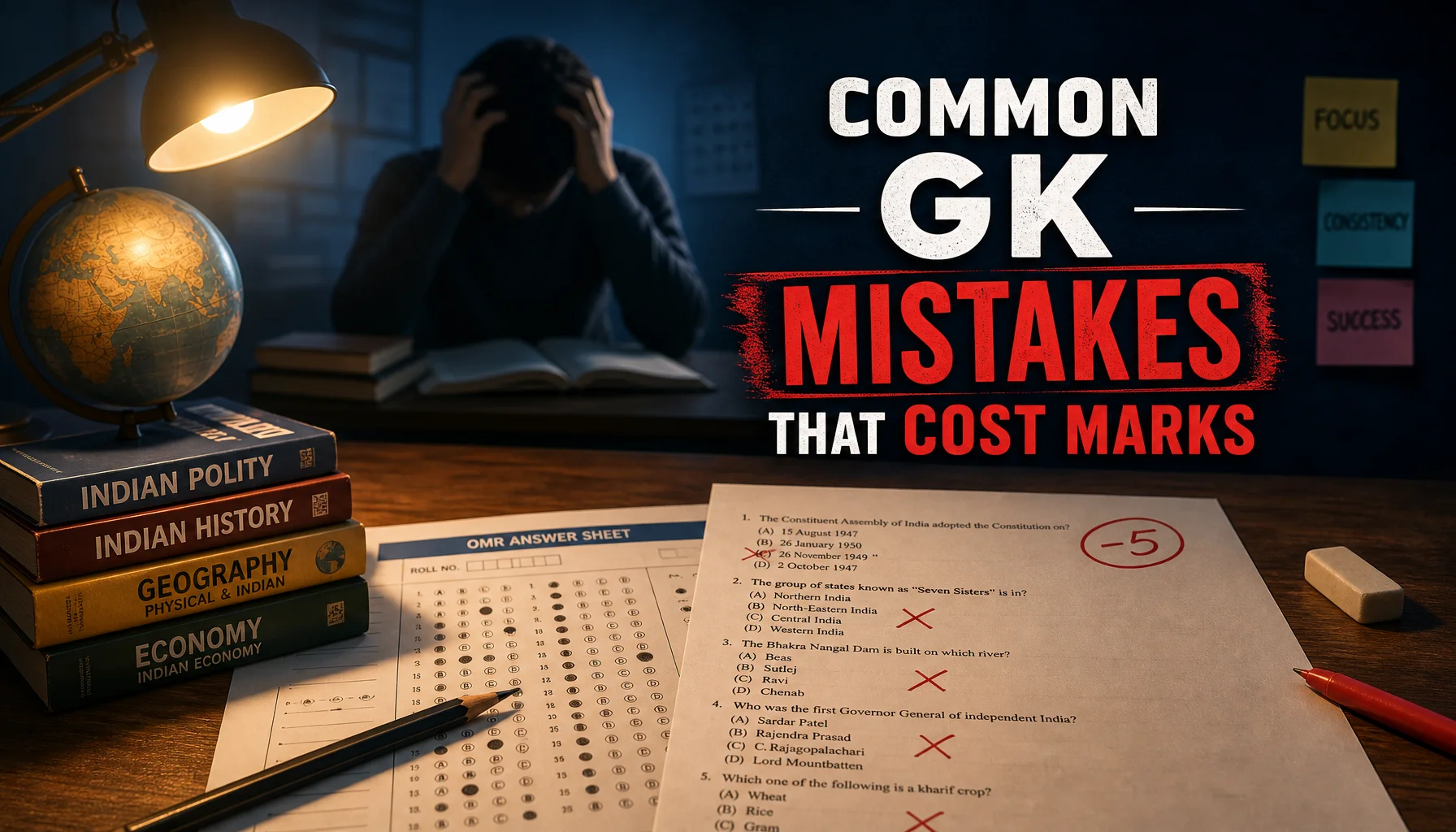
General Knowledge (GK) is often considered the easiest scoring section in competitive and entrance exams. After all, either you know the answer or you don’t, right? Yet every year, thousands of well-prepared students lose crucial marks in this very section—not because they didn’t study, but because they fell for predictable traps, confused similar facts, or misread cleverly worded questions. In a competitive landscape where a single mark can decide your rank, these avoidable errors carry a heavy cost.Who Can Apply
This article breaks down the most common GK mistakes students make, highlights frequently confused facts, and gives you practical strategies to avoid these pitfalls on exam day. Whether you’re preparing for banking exams, civil services, SSC, or college entrance tests, understanding these traps can meaningfully improve your score.
1. Confusing Similar Facts and Figures
One of the biggest sources of GK errors is the mix-up between facts that look almost identical. Exam setters deliberately design questions around these confusions, knowing that students often memorize information superficially.
Commonly Confused Pairs
- First vs. Longest vs. Largest: Students frequently swap the “first woman to do X” with the “youngest” or “only” woman. Read the qualifier carefully.
- Founders vs. Presidents: Who founded an organization is often different from who currently heads it or who was its first leader.
- Rivers and their tributaries: The origin, the states a river passes through, and the point where it meets the sea are all separate facts that get jumbled.
- Awards and their fields: The Nobel Prize categories, the difference between civilian awards like Bharat Ratna and Padma awards, and their years of introduction are common trap zones.
How to avoid it: When you study, create comparison tables. Instead of learning facts in isolation, group similar items side by side so your brain registers the distinctions clearly.sarkari result
2. Ignoring the Exact Wording of the Question
Many students lose marks not because they lack knowledge, but because they answer a different question than the one asked. Words like “not,” “except,” “incorrect,” “only,” and “always” completely change the meaning of a question.
Consider a question that asks: “Which of the following is NOT a landlocked country?” A student who reads quickly might select a landlocked country instead of the correct answer. This kind of error is entirely preventable.
- Underline or mentally flag negative words like “not” and “except.”
- Be cautious with absolute terms such as “always” and “never,” which are often signs of a false statement.
- Re-read the question stem before selecting an option, especially in “assertion and reason” formats.
3. Relying on Outdated Information
GK is dynamic. Current affairs, appointments, sports records, and government schemes change constantly. A fact that was correct last year may now be outdated—and exam setters love to test whether you’re up to date.prepare
Common outdated-information mistakes include:
- Naming a former minister, CEO, or chairperson instead of the current one.
- Citing old capital cities or renamed places (many cities and stadiums have been renamed).
- Referencing superseded sports records or previous tournament winners.
How to avoid it: Dedicate the last two to three months before your exam to revising the most recent current affairs. Keep a monthly current-affairs digest and revise it repeatedly rather than trying to memorize a year’s worth at the last minute.
4. Overthinking and Second-Guessing
GK is a section where your first instinct is often right. Yet students frequently change a correct answer to a wrong one because they overthink under pressure. The fear of choosing “too obvious” an answer leads them into traps.
Exam setters sometimes place a straightforward answer as the correct option precisely because they expect students to doubt it. Trust your preparation. Only change an answer if you have a concrete reason—such as remembering a specific fact—not just a vague feeling of doubt.
5. Weak Grasp of Static GK
Static GK—history, geography, polity, science basics, and constitutional facts—forms the backbone of most exams. Students who focus only on current affairs often stumble on static questions that require precise recall.
Frequently Missed Static Topics
- Constitutional articles and amendments: Which article deals with what is a classic confusion zone.
- Historical dates and dynasties: The sequence of rulers and events is easily jumbled.
- Scientific units and discoveries: Who discovered what, and the correct SI units, are common slip-ups.
- Geographical boundaries and neighbors: Which countries share borders and the order of states are frequently tested.
How to avoid it: Use mnemonics, flashcards, and spaced repetition. Static GK rewards consistent revision more than intensive last-minute cramming.
6. Poor Time and Guessing Strategy
Even with strong knowledge, a flawed strategy costs marks. Many exams have negative marking, so blind guessing can hurt more than help. Conversely, being overly cautious means leaving winnable marks on the table.
- Eliminate options: If you can rule out two choices, an educated guess becomes statistically worthwhile.
- Know the negative marking scheme: Adjust your risk-taking based on how much a wrong answer costs.
- Don’t linger: GK questions should be quick. If you don’t know it in a few seconds, mark it for review and move on.
7. Neglecting Regional and Exam-Specific GK
Different exams emphasize different areas. State-level exams often include regional history, culture, and geography, while national exams lean toward broader topics. Students who prepare with a generic approach miss out on exam-specific patterns.
How to avoid it: Analyze previous years’ papers for your specific exam. This reveals recurring themes and the weightage given to each topic, letting you focus your energy where it counts most.
Quick Checklist to Avoid GK Mistakes
- Study confusing facts in comparison tables, not in isolation.
- Read every question twice, watching for “not” and “except.”
- Prioritize recent current affairs in the final months.
- Trust your first instinct unless you have a solid reason to change.
- Revise static GK consistently using flashcards and mnemonics.
- Use elimination and understand the negative-marking rules.
- Practice with previous years’ papers for your target exam.
Conclusion
GK can be your strongest ally or your biggest weakness, depending on how carefully you prepare and how alertly you approach the exam. Most lost marks in this section come not from a lack of knowledge, but from careless reading, outdated facts, and poor exam-day judgment. By learning to spot commonly confused facts, respecting the exact wording of questions, and following a disciplined revision routine, you can convert GK into a reliable source of high marks. Study smart, stay updated, and read every question with care—your rank will thank you for it.

About the Author
ramyaji
A content writer with two years of experience in the government recruitment domain. He simplifies official notifications and exam updates for SSC, UPSC, Banking, Railways, and State PSCs, helping aspirants stay informed at every stage of their preparation.