
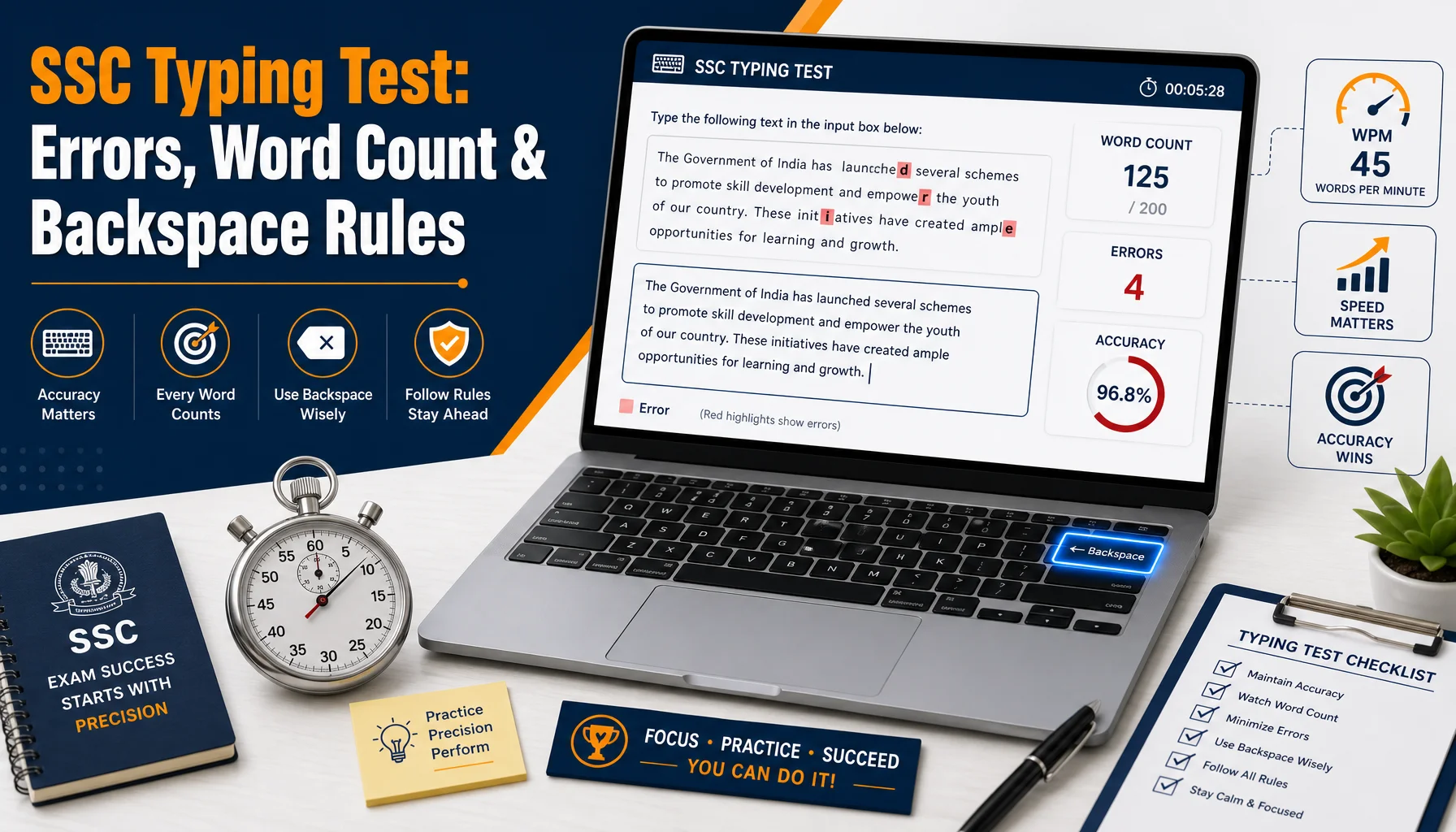
If you’re preparing for the SSC (Staff Selection Commission) or RRB typing test, you already know that speed alone won’t get you through. The real challenge lies in understanding how your performance is evaluated. Many candidates with lightning-fast typing speeds still fail simply because they don’t understand the marking scheme, how errors are counted, or which keys they’re allowed to use during the test. In this detailed guide, we’ll break down the entire evaluation process—word count calculation, error deductions, and the all-important question of whether the backspace key is permitted.scoring marks
Understanding the Basics of the SSC Typing Test
The SSC typing test (also known as the Skill Test or Typing Test) is a qualifying stage for posts like Lower Division Clerk (LDC), Data Entry Operator (DEO), and various clerical positions. While it is qualifying in nature—meaning your final merit is based on the written exam—you must clear it to be eligible for the post.
The test typically requires candidates to type a given passage within a fixed time limit, usually 10 minutes. The required speed varies by post and language:
- English typing: 35 words per minute (WPM)
- Hindi typing: 30 words per minute (WPM)
These speeds translate to approximately 10,500 key depressions per hour for English and 9,000 for Hindi. Understanding this conversion is crucial because the evaluation is based on key depressions, not just visible words.competitive exams
How Word Count Is Calculated
One of the most misunderstood aspects of the typing test is how words are actually counted. In SSC typing evaluation, a “word” is not defined by spaces or grammar. Instead, the standard convention is:
1 word = 5 key depressions (including spaces).
This means every character you type—letters, punctuation marks, and even the space bar—counts as a key depression. To calculate your gross speed, the total number of key depressions is divided by 5, and then by the number of minutes.
Example Calculation
Suppose you type 1,750 key depressions in a 10-minute test:
- Total words = 1,750 ÷ 5 = 350 words
- Gross speed = 350 ÷ 10 = 35 WPM
This is exactly why you must aim to type slightly above the required speed. If you target precisely 35 WPM with no buffer, a few errors could push you below the qualifying mark.Clerk
How Errors Are Counted and Deducted
Errors are where most candidates lose their qualification. The SSC evaluation distinguishes between full mistakes and half mistakes. Understanding this distinction can help you focus your practice where it matters.
Full Mistakes
A full mistake typically counts as one complete error. Common examples include:
- Omission of a word from the passage
- Substitution of a wrong word
- Addition of an extra word that isn’t in the original text
- Spelling errors that change the word entirely
- Repetition of a word or phrase
Half Mistakes
Half mistakes are minor errors that count as 0.5 of an error. These usually include:
- Wrong capitalization (typing lowercase instead of uppercase or vice versa)
- Incorrect punctuation or spacing
- Minor spacing issues between words
Two half mistakes are generally combined to count as one full mistake during evaluation.
Gross Speed vs. Net Speed
The distinction between gross and net speed is central to understanding your final result.
- Gross speed: The total typing speed before any error deductions.
- Net speed: The speed after subtracting errors from your word count.
In many SSC skill tests, the evaluation is based on the percentage of errors allowed rather than a strict net-speed formula. Historically, SSC has permitted a small margin of error—often around 5% to 7% of the total word count, depending on the exam notification. Always check the specific rules mentioned in the official notification for your exam, as these percentages can change.
Error Percentage Example
If a passage contains 350 words and the allowed error margin is 5%, you can make up to about 17 full mistakes and still qualify. Exceeding this threshold results in disqualification, regardless of your speed.
Is the Backspace Key Allowed?
This is perhaps the most frequently asked question among candidates—and the answer brings good news for most test-takers.
Yes, the backspace key is generally allowed during the SSC typing test. Candidates are permitted to use the backspace and delete keys to correct their mistakes as they type. This is a significant relief, as it allows you to fix obvious typos on the fly.
However, there are important nuances to keep in mind:
- Correcting doesn’t erase the time cost. Every time you hit backspace and retype, you lose precious seconds. Excessive use of backspace can drastically reduce your overall speed.
- Uncorrected errors still count. If you don’t fix a mistake, it will be counted against you during evaluation.
- Some other typing keys may be restricted. Depending on the software used, keys like arrow keys, tab, or certain shortcuts may be disabled. Always read the on-screen instructions before beginning.
The general strategy is to use backspace sparingly—only for immediate, obvious errors. Chasing perfection by constantly correcting minor mistakes will hurt your speed more than a few uncorrected half-mistakes would.
Smart Strategies to Maximize Your Score
Now that you understand the evaluation mechanics, here are practical tips to improve your chances of qualifying:
- Aim for a buffer speed. Practice at 40–45 WPM so that even with errors, your net speed stays above the requirement.
- Prioritize accuracy over raw speed. Since errors carry heavy penalties, a slightly slower but accurate approach often works better.
- Don’t obsess over backspacing. Fix major word errors, but let tiny formatting mistakes go if correcting them costs too much time.
- Practice on the actual keyboard layout. If the test uses a specific software or key layout, replicate it in your practice sessions.
- Read the passage in chunks. Typing in phrases rather than single words improves flow and reduces omission errors.
Conclusion
The SSC and RRB typing tests reward candidates who understand the system as much as those who type fast. Remember that a “word” equals five key depressions, errors are split into full and half mistakes, and there’s usually a small error margin that determines pass or fail. Most importantly, the backspace key is allowed—but use it wisely, because time is your most valuable resource during the test. By practicing with these evaluation rules in mind and always confirming the specific guidelines in your official exam notification, you’ll walk into the skill test with the confidence and strategy needed to clear it comfortably.

About the Author
mani_kandan
A dedicated content writer specializing in government job notifications and results. With two years of experience covering SSC, UPSC, Banking, Railways, and State PSC examinations, he delivers reliable, well-researched updates tailored for serious government job aspirants.